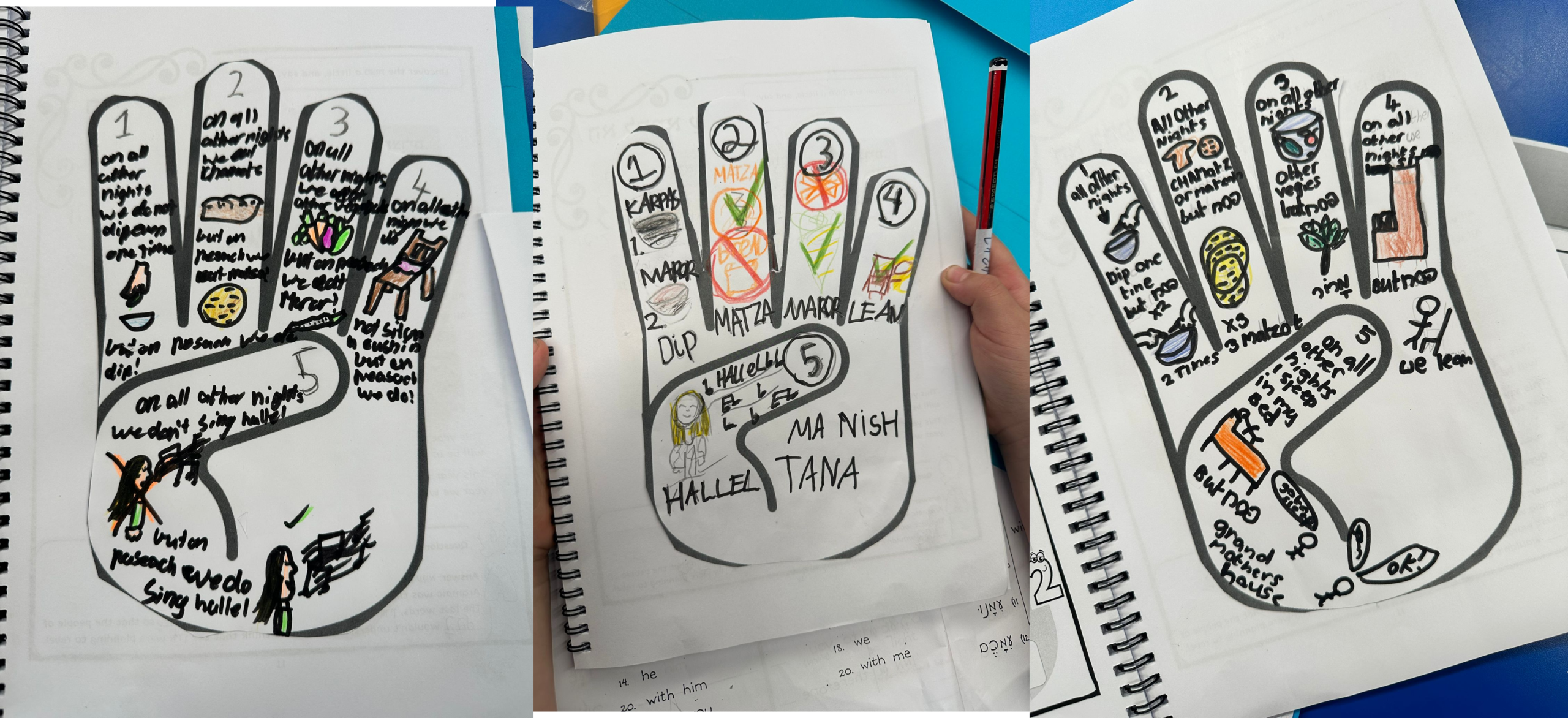
Yehudis Kluwgant, a Primary School Teacher at Beth Rivkah College in Melbourne, has shared a great lesson idea based on a skill that she learned on our Rimonim program.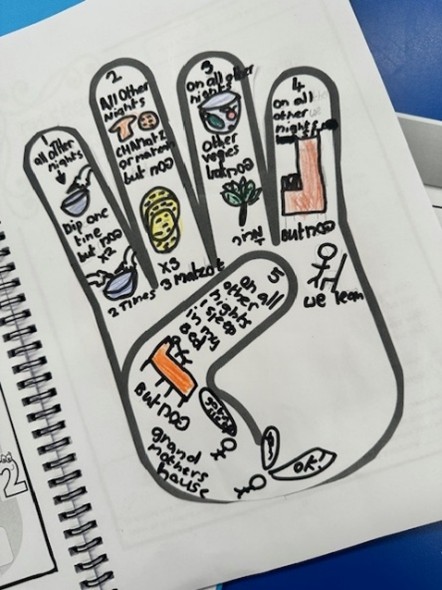 Yehudis took the traditional Mah Nishtanah and gave it a creative twist, asking her Grade 3 students to look beyond the printed page to find a personal connection to Pesach. Using a technique called sketch-noting, which she learned about at a workshop with Emily Shapiro Katz on Rimonim’s recent Israel Semester, students mapped out the traditional four questions on the four fingers of a hand-shaped template, reserving the palm and thumb spaces for something new: their Fifth Question.
Yehudis explains: “While the Seder night is built on the foundation of four specific questions, the true spirit of the Haggadah is to ignite curiosity and make the Exodus feel like our own personal journey. To challenge our students’ Higher-Order Thinking Skills (HOTS), we didn’t just learn the Four Questions, we looked for the Fifth. The goal was to move beyond rote memorization to meaningful reflection. By asking, “If you could add a Fifth Question at the Seder, what would it be?” students were encouraged to analyze the themes of freedom, tradition, and family through their own lens.”
One of the most heartwarming examples from the class (pictured here) shows a student connecting the Seder to their own family geography. Her Fifth Question focused on her change in environment: “On all other nights I sleep in my bed, but now… at grandmother’s house!” By allowing students to author a part of the Seder, we achieve several educational goals.
- Synthesis: Combining the ancient text with modern, personal experience.
- Analysis: Identifying the “differentness” of the night beyond just the food.
- Ownership: Transforming the Pesach story from a historical event into “My Story.”
Interested in finding out more about sketch-noting and other active learning techniques for your classroom? Contact herzogolami@herzog.ac.il