Ami Magazine: THEY ANSWERED THE CALL
A groundbreaking training program is helping educators around the world hone their Torah-teaching skills.
Ami Magazine — May 18, 2026 / 2 Sivan 5786 – Download the PDF here.
Amsterdam, NL — By Yossi Krausz
When Sushi Becomes a Sugya
When Rabbi Doedi Van Dijk, a rebbi in Amsterdam’s Cheider yeshivah high school, realized that his students weren’t as engaged as he wanted them to be, he realized that sushi was the answer. Not eating sushi, but using it as a teaching tool.
Having the students apply the halachos they were learning in Gemara to real-life cases involving sushi—and actually making some sushi as they went—would be a way to bring the Gemara into their lives and immerse them in its texts.
The project his class engaged in (and the next one, as well, which involved barbecue!) is fascinating on its own. But it was just a part of a larger project in the Jewish schools in Amsterdam, which stem from a single question: How can a small Jewish community access advanced teacher training for its educators?
In a city like Yerushalayim, New York or London, there are institutions that are dedicated to providing teachers, both rebbeim and morahs, with the newest pedagogical tools. But Amsterdam is a small community. How could they gain those tools and skills?
The answer, it turned out, was with outside help. This past year, an initiative developed at Herzog College in Israel has been enabling limudei kodesh teachers in Amsterdam—like it has in other cities around the world—to refine and develop their teaching practices in a way previously only available in large cities.
The practical benefits were most important. But there was also a symbolic and communal aspect this year. The Cheider, one of the schools that has benefited from the program, was targeted with a bomb attack in March. The community in general has been a target of anti-Semitic rhetoric and abuse since the October 7 attacks. The connection of the teachers of the community with a wider community of educators is a sign and signal that they are not alone.
To understand more about how this program worked, we spoke with Shoshanna Haas, a native of Amsterdam now living in Antwerp, Belgium. She previously had worked at the Cheider in Amsterdam, and after her move to Antwerp, she began working at Jesode Hatora, in their Bais Yaakov, as a curriculum coordinator for the Hebrew department and as a teacher of Jewish history. Herzog College approached Mrs. Haas, who has a master’s degree in education and history, to serve as the local facilitator for the Amsterdam program.
Coming Together for Tools
A core part of the idea of a Learning Lab in Holland was that teachers who don’t have degrees in teaching would be able to access advanced teaching concepts.
She said, “Their experts saw a need in Jewish day schools for a course for teachers who didn’t go through an official teacher training, who might be lacking the background of pedagogy or didactics, how to prepare a lesson, and things like that. Usually, the teachers know the material they are teaching very well, but they didn’t necessarily learn the structure of what makes you a teacher.”
Two schools joined the program: the Cheider, which has both a yeshivah and a Bais Yaakov; and Maimonides and Rosh Pina, which are the elementary and high school division of the Modern Orthodox school. The Seminarium, a community learning institution, itself historically a teacher training program, provides its facilities, logistics help and part of the funding.
“Until the Second World War, that’s the place where every Jewish teacher got a teacher’s degree,” Mrs. Haas said. “It wasn’t a university course, but it was an official course that had three levels where they could learn how to be a teacher. After the Holocaust, the community was so small that they didn’t organize it anymore in such a way. So people could just go there for courses to learn a bit about Yiddishkeit but not really follow a teacher training. That’s why they are also participating.”
Funding for the program came both from inside the community and from outside. Maror, a community funding organization through which the government provides reparations, helped pay for it, and so did the international organizations UnitED and the Pincus Fund, the Rothschild Foundation and the Yael Foundation, as well as the Israeli Ministry of Diaspora Affairs and Combating Antisemitism.
 What Is Taught
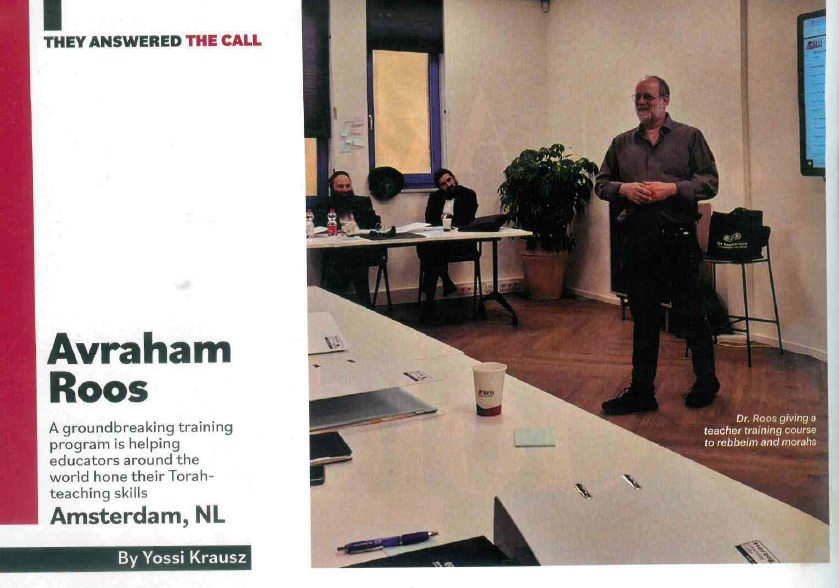
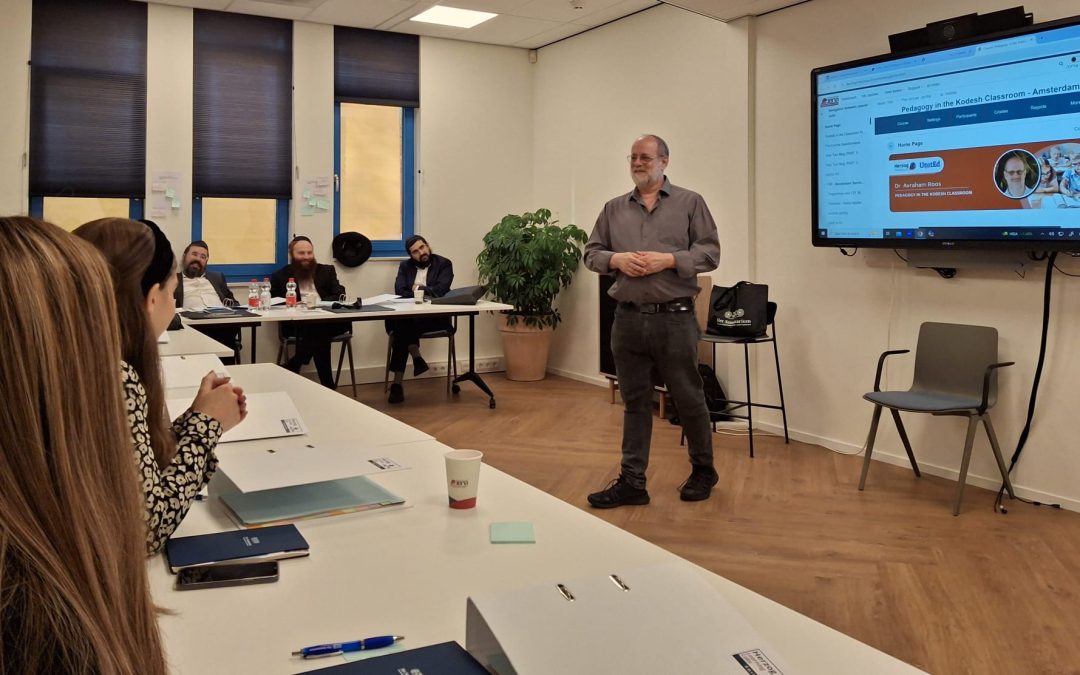
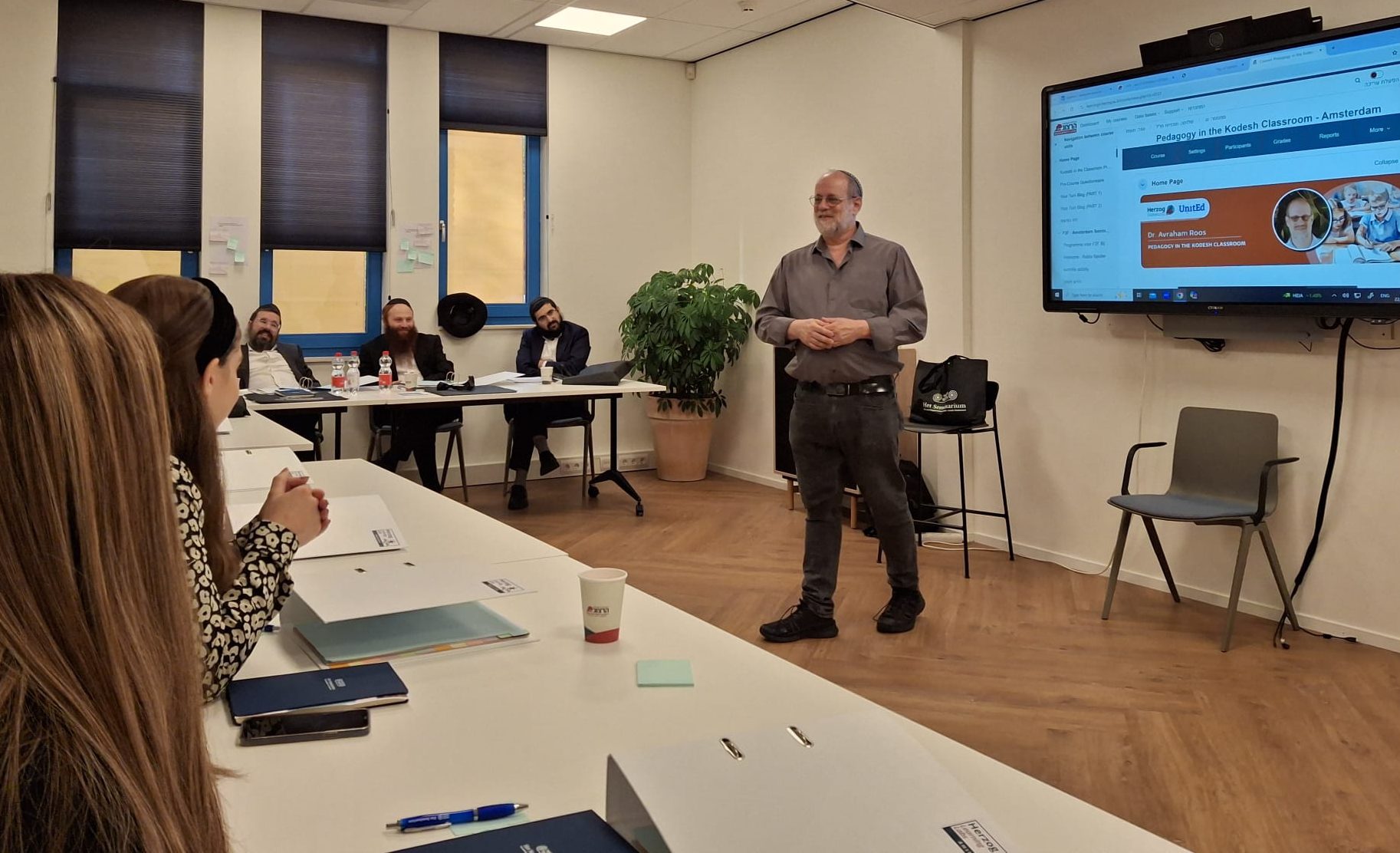
At the outset of the course, the developer of the course, Dr. Avraham Roos, came to Amsterdam to give an initial series of workshops. He also gave Zoom classes throughout the year with the entire group of teachers, and he graded their assignments. Other than that, the day-to-day work was carried out by Mrs. Haas. The course was a combination of in-person study and asynchronous homework.
“Once a month, I travel to Amsterdam, which is about an hour and a half by train from Antwerp,” she said. “On these monthly occasions, we have face-to-face teacher training. The teachers can sit in groups and discuss things that have been going on over the past month. We go deeper into the material of the online course, and they also get some assignments.”
She said that the fact that the main part of the course is asynchronous and everyone is essentially working at home, at their own pace, means that having those in-person sessions is very important for facilitating both discussions and growth.
The rest of the month, there is a weekly Zoom meeting in which they come together to discuss the coursework as well as the challenges they are seeing in their classrooms. There are also options for one-on-one coaching if teachers feel they need to speak about issues individually.
Individual but Together
“It’s interesting to watch how staff members with different philosophies are able to work together.”
Unlike training in larger cities, where all of the attendees are usually one age and one cohort, this kind of small community training brings together a mix of teachers.
“We have a very, very diverse group of teachers,” Mrs. Haas said. “Hashkafically, some are more chareidi, some are less so, and some are not frum. They also have very different classroom settings. Some of them have a class of 30 students, some have a class of three students. Some teach language, some teach Gemara. Some have one year of experience, others have 30 years of experience. We have a teacher that I think is 19 or 20, and the oldest has 30 years of experience teaching.
“Obviously, they are all different. They have different characters and different challenges. One may struggle with classroom management and another with differentiation. It’s very diverse, and that’s why it’s good that the course is very individual as well. Everybody learns all the material, and then they can reflect on their own challenges and pick the points that they want to work on specifically.
“Each has a portfolio where they keep track of their development. At the beginning of the year, they filled out a rubric where they graded themselves in five different topics: pedagogy, didactics, organization, interpersonal relations and reflection.
“These five topics all together comprise what a teacher is. Each of the participants has challenges in different areas. By filling out those rubrics, they basically chose their own points to work on throughout the year. And at the end of the year, we’ll have a session where they present their portfolios and give a presentation to the group, answering questions like ‘what development did I go through?’ ‘What were my challenges?’ ‘What did I learn in the course that helped me face my challenges, and in which way did I grow?’
“That’s the power of this course. It caters to a very diverse public, and each one can have their own development even though they’re all following the same course.”
She explained the five aspects of teaching that the course focuses on:
“Pedagogy is how you work with children, how you communicate with them, how you understand their emotions. What kind of things do you do in the classroom to connect with them and to make sure that your lesson works? “Didactics is how you build your lesson. What do you do in your lesson that makes the learning happen? So, for example, they learned about backward design.
“Many teachers, especially the ones who didn’t have teacher training, take the material and say, ‘Okay, what do I have to teach? It’s pasuk alef until hei. And then they think, ‘Okay, so I’ll prepare a few questions and that’s my lesson.’
“But what they learned in this course is to do backward design and to first think about the goals they want to achieve instead of thinking about the material. ‘What do I want each student to be able to know or to be able to do after my lesson?’ And then they start thinking, ‘How do I get there? How do I need to build my lesson in order to achieve my goals?’ It’s a flipped way of thinking. That’s one example of didactics, of how you build your lesson.
“The third aspect, organization, is very broad. It includes how you organize your preparations. How do you make sure that you prepare your lessons in time? How do you make sure that you have all the materials you need when you get to the class? How do you make a filing system?
“Then there’s interpersonal relations. It includes how you communicate with your students, but also communicating with colleagues, with parents, and with the hanhalah.
“The last is reflection. That’s a skill that every teacher needs – to reflect on what went well today, what didn’t go so well today, and how I can do it better next time.”
Sushi and Learning
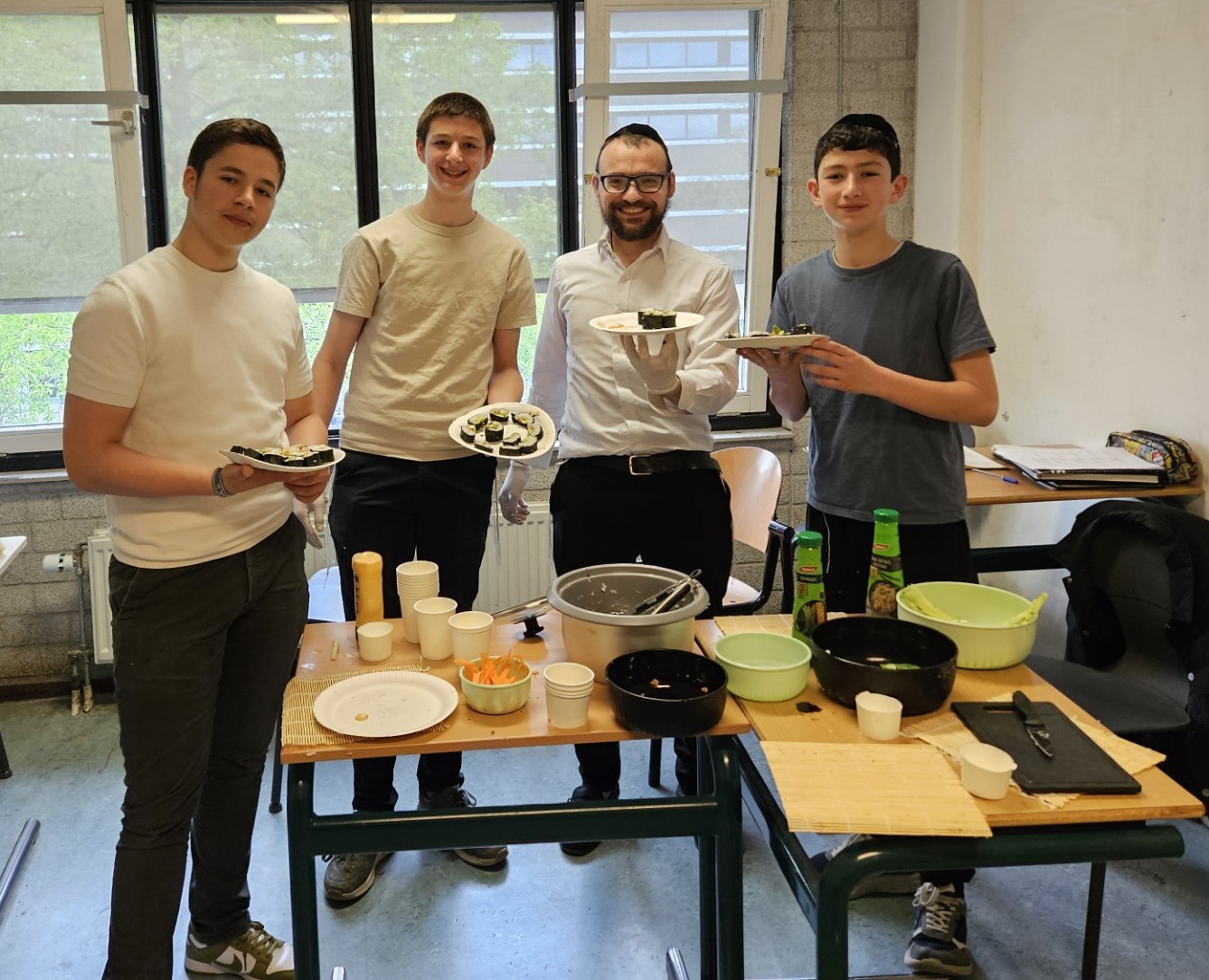
Rabbi van Dijk and talmidim with their sushi
This kind of self-reflection on teaching methods was critical for Rabbi van Dijk’s decision to use sushi as a way to teach Gemara.
“He has a class of high school talmidim, and he noticed that he didn’t really reach his students the way he wanted to in his Gemara curriculum. They didn’t have geshmak in the learning, and he just felt he wasn’t really making progress the way he wanted.
“He had been struggling with that for a while. And then he was looking at the things he learned in the course. One of the things is that it teaches you to be out of the box, to think, ‘Okay, this is how I did it until now. What new thing could I try that would work for this group?’ And that’s how he came up with the sushi project.
“He spoke to the hanhalah (management), and they agreed that it was okay. So he closed the Gemara and decided to just get the geshmak in learning and do something that speaks to them, and through that hopefully go back to the Gemara with more geshmak (enthusiasm).
“He’s a relatively new teacher; he’s very enthusiastic. That helps. But I think the course gave him the tools to think concretely: ‘How can I build a better relationship with my students?’ And to try something new.
“He asked the students what topic they would like to learn about, and they came up with sushi. He guided them to find sources and to look into questions like whether you can make sushi on Shabbos, as well as issues of basar b’chalav, the brachos, and all sorts of things. It gave them geshmak in the learning and improved the atmosphere.”
A Community Under Threat
The Jewish community in the Netherlands has faced a great deal of anti-Jewish hate. That lends a resonance to this group.
“I think it’s the first time in the history of Amsterdam that these two schools have worked together,” Mrs. Haas said. “Obviously, there are some differences in hashkafah. After October 7, we feel that we’re united, we’re all in the same boat. Anti-Semitism unfortunately always has a unifying power.”
Increased anti-Semitism also means that a safe space for training is welcome. “I don’t think all teachers feel safe to go to a general college or university to enroll in teaching courses there, especially nowadays,” she said.
You also wouldn’t learn the things this course teaches you. “If you go to a general teacher training, of course you’ll learn the pedagogy and the didactics, but you won’t have real-life examples about a Chumash lesson. How do you apply this to a Gemara class? How do you do this with a Jewish history lesson? The specific focus on the kodesh subjects is very important.”
Mrs. Haas said that the community is resilient, and the schools have tried to create an atmosphere where students can talk about the threats without focusing too much on them in a way that could be negative. Because the attempted bombing attack at the Cheider took place before Pesach, the teachers tied it in with V’hi She’amdah and put it in the context of Jewish history.
She noted that resilience is part of Amsterdam’s Jewish history. “Many people know about the percentage of Jews that were killed in Poland, which is over 80%. Not many people know that in Amsterdam the percentage was more or less the same.” That destruction and resilience is encapsulated in the founding of the Cheider in the 1970s.
When Uri Yehuda “Adje” Cohen, the founder of the Cheider, went to the Dutch government for permission to open the school, the government response was that there were too few students to open the school.
Mrs. Haas said, “He replied, ‘What do you mean? We have 30 students in each class.’
“They said, ‘No. According to this list, you have two students in each class.’
“He said, ‘That’s correct. The other 28 were killed during the war.’”
The Cheider opened, and it has educated the chareidi students of Amsterdam ever since. And resilience and finding resources despite the small size of the community has been a part of the educational system until today.
Hilchos Sushi
What kind of halachos did the Cheider boys learn? Rabbi Reuven Spolter of Herzog College gave us a few examples from the Dutch-language curriculum that was developed by Rabbi van Dijk
- Is it permissible to make sushi on Shabbos? This led to a complex study of the laws of tochein (grinding) and boneh (building). Does slicing a cucumber too thinly violate tochein? Does pressing rice count as construction?
- What is the correct brachah to make on sushi? The students debated whether the rice is primary (ikar) or if each ingredient stands alone. They navigated the machlokes between the Shulchan Aruch Harav and other poskim, concluding that you may sometimes need to make four brachos in one sitting!
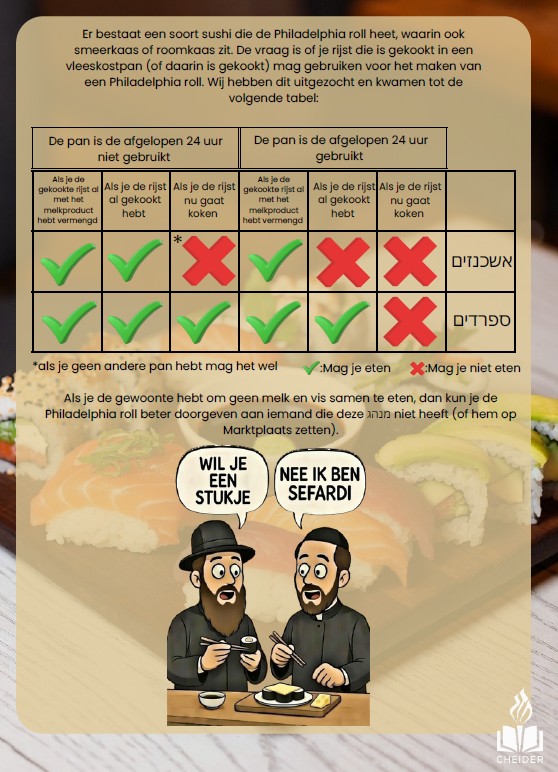
- The Philadelphia Roll challenge: Are you allowed to use rice that was cooked in a fleishig pan to make a sushi roll with cream cheese? The students created a color-coded halachic flow chart to determine when it is permitted. (Hint: Ben yomo issues and taam played a big role.)
Shown here: part of a brochure made by Rabbi van Dijk and his talmidim.